Wednesday, November 1, 2006

Zoe and her Many Meows

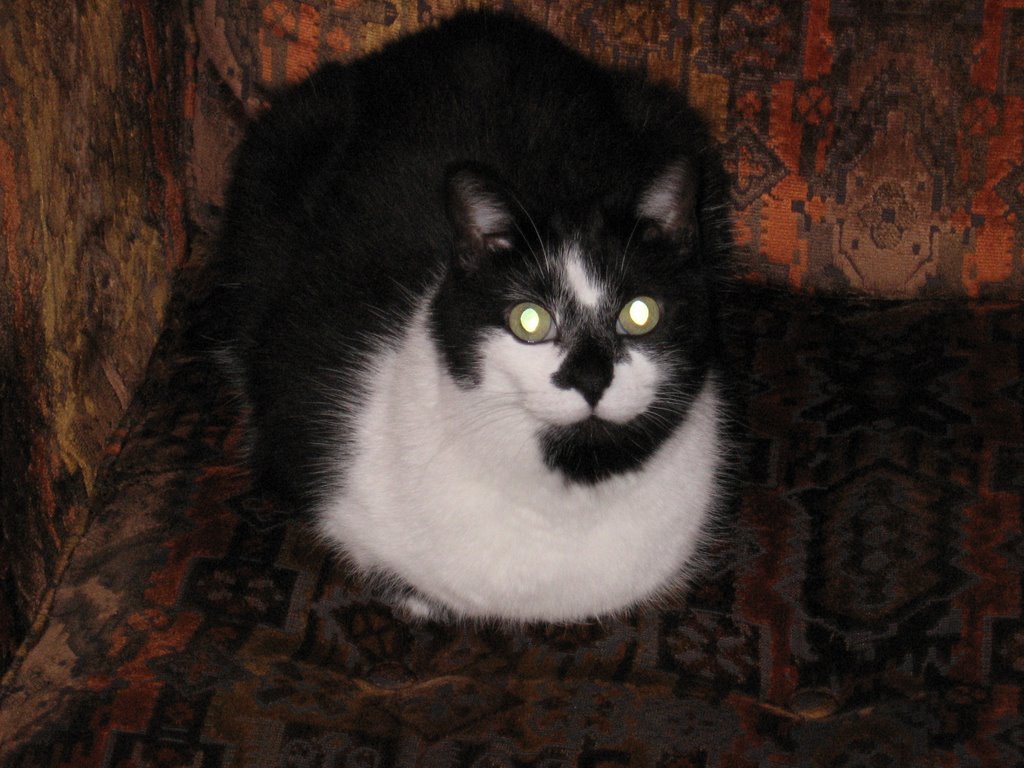
This is Zoe. She is our modern art cat... black and white, sort of like "op art."
Zoe is a feline alarm clock. She meows loudly at my parents' bedroom door early in the morning. They usually don't answer until they are ready to. That doesn't stop her from making long, involved speeches. She has a variety of meows, which she uses to express different needs. There's the "get out of bed" meow, which I have previously mentioned. There is the "feed me" meow, which is then followed by the "maybe I want food, maybe I don't dance," which includes Zoe hiding under the dining room table while my mom calls her. She comes when she is ready and not before. Another type of meow is the "open the door" meow, for the patio and the basement. She looks at the doors and says exactly what she expects the human to do. Of course, the human (usually me), being well-trained, does exactly what the cat expects. Zoe's most interesting meow is the after-dinner meowing session at the top of the stairs. It's hard to tell what message she is trying to communicate, but she makes a long speech. It could be that she is reviewing the quality of the food and its presentation, but no one, except for the big Maine Coon cat, Smokey, speaks cat. So we don't have a clue.
Zoe and Smokey, of course, also speak to each other. There are friendly, conversational meows. Then there are the wrestling matches and chase games, which lead to somewhat furious meows and even a few hisses.
When Zoe isn't using her vast storehouse of verbal skills, she likes to play games. She has various toys, including stuffed mice and a few balls, that she likes to play with. She also likes twist ties and plastic bags, but the humans have to discourage the use of plastic bags as cat toys. Another fun activity for Zoe is to hide until the humans start wondering where Zoe is. When the humans have become frantic because they cannot find Zoe, she nonchalantly appears and gives the humans the "why are humans so stupid" look. It is a look that she has refined from constant usage. She also uses that expression after being offered food that she doesn't like. The humans take note and don't serve her the offending food any more.
I have become a great toy for Zoe. Ever since she was a kitten, she has enjoyed feet. Human feet, that is. She likes to sit on top of the bed in the middle of the night and bite feet through the blanket. She watches the feet move and then jumps at them and her mouth opens wide as she prepares for the bite. It is truly a happy moment for Zoe when she takes a great big bite, even though she gets nothing in her mouth but blanket.
Zoe, despite being a full-grown cat, is very kittenish in nature. She loves to chase her own tail. She runs around and around in circles. Sometimes, she catches her tail. Then she bites it. She must bite it fairly hard because she then meows and looks to see what or who bit her tail. She isn't quite aware that her tail is attached to her when she is in Bite Mode, and, when she is in Hunt for the Culprit Mode, she isn't quite aware that it was she who bit her own tail.
As soon as I can get a picture of Zoe's friend, Smokey, I'll tell you more about him.

Saturday, October 21, 2006

Buffalo's disastrous storm


Painting autumnal trees was the theme of artist Jinni Kelley’s watercolor class at Stella Niagara, in Lewiston, on October 12. While at this class, I learned how to use paintbrushes and sponges to give the effect of red, yellow, and orange leaves. Although the class was not painting an actual outdoor scene, our paintings reflected the reality of the world outside, at that moment.

After class, Jinni took me to my friend Ellen’s house in north Buffalo, where I was to housesit for the weekend. As we traveled south, the reality of the world outside underwent a drastic alteration. The sky abruptly darkened and large snowflakes started falling.

After Jinni returned to Niagara County, I took out the garbage, prepared dinner, and went to choir practice at Blessed Sacrament Church on Delaware Avenue. The group at rehearsal numbered just thirteen, including choir director Frank Scinta. He commented on the “Blessed Sacrament Chamber Choir,” but he cut rehearsal short. When we left the church, we could see that the snow was coming faster than ever and that the weight of the wet, heavy snow dragged tree limbs down. Frank drove me back to Ellen’s house. We traveled down Delaware Avenue, past Delaware Park and Forest Lawn Cemetery. Driving was slow and arduous. When we were ready to turn onto Ellen’s street, we saw that it had become a terrifying sight. Broken tree branches lay everywhere, even in the middle of the street. I got out the car and could hear tree branches snap and crash to the ground. I ran to indoor safety.

In the morning, the telephone jarred me awake.

“Do you have electricity?” a neighbor asked.

I clicked on the lamp, which did not light. “No.”

Once I awakened, I went outside to photograph the street scene. Tree limbs were strewn everywhere. I went into the dining room and saw a tree limb leaning toward the back window. I didn’t recall that there had ever been a tree in the backyard. I looked again and noticed that this tree was actually the top of the neighbor’s tree, which had bent into Ellen’s yard. “There is a tree on the power lines,” I told a National Grid employee over the phone. She made out a work order.

I fed the fish, ate sandwiches, drew pictures, and cleaned the bird cages. Outside, the wind screamed. At night, I tried to write in my journal, but my fingers were cold and the flashlight didn’t help much. I crawled under the comforter and slept.

On Saturday morning, the house temperature was 54 degrees. Outside, the snow was melting, leaving puddles amidst the piles of branches and debris. I fed the birds and fish. I tried playing the piano while wearing gloves. The birds liked singing with a piano accompaniment. I wondered what was going on in the world. It had been two days since I had heard the news or read a newspaper. Fortunately, I still had telephone service. Ellen called shortly before dark and said that she and her children would soon pick up the birds. She didn’t want me to develop hypothermia. Go home, she said. Tomorrow, I said. After I feed the birds.

Those two birds were amazing. They still sang, despite the chill and darkness. My sister Vivian, who called a few times to give me tips on avoiding hypothermia, said that she would pick me up early on Sunday afternoon.

Darkness came early. I covered the bird cages with towels, and I went to bed.

In the morning, I tried pulling a tree branch from the driveway with no success. I rolled the empty garbage bin away from the street. Inside the house, it was 50 degrees. Vivian arrived and brought me back to Grand Island. She told my parents that Ellen’s street looked like “an atom bomb hit it.” I felt very lucky to be able to go to a warm house, where I could eat hot food and read at night.

In my art bag, I carried with me paintings of trees that looked peaceful and whole, with colorful and bright leaves. I wondered if the broken trees of north Buffalo would ever again resemble those paintings.

Monday, October 9, 2006

Dracula (the ballet)

During my last evening with the Franciscan Sisters of Perpetual Adoration, I was offered a ticket to a production of Dracula at Viterbo University. I was very eager and enthusiastic about attending this performance. I had wondered how the Dracula story might be performed as a ballet. I was especially interested in finding out how someone could bite necks and dance at the same time. That is certainly a more difficult undertaking than walking and chewing gum at the same time, yet many people can't do that (including me, on occasion).
The ballet, presented by the Royal Winnipeg Ballet of Canada, lived up to my hopes and then some. The choreography by Mark Golden and music by Gustav Mahler combined to tell Bram Stoker's story in a different and creative way. It was truly a multimedia production, with words projected on a screen, a backstage story teller, pantomime, dancing, and theatrical fog. The stark sets and the barely illuminated stage created an image of foreboding that made the tale of the vampire come to life.
The performers did the rest to re-create Bram Stoker's tale. Like F.W. Murnau's 1922 silent film Nosferatu (starring Max Schreck in the title role), the ballet tried to be faithful to the original story. The first half of the production was a ballet version of the entire story and the second half featured pantomimed variations on the theme of Dracula. The performances, especially by Dracula (Johnny Wright) and Lucy (Vanessa Lawson), were sensual and compelling. The relationship between Dracula and Lucy seemed strangely symbiotic and surreal. The pair inhabited a world that existed somewhere between wakefulness and sleep, where nothing felt quite real.
Bram Stoker's Dracula. of course, bears almost no relationship to the actual historical figure of Dracula. Vlad Dracula lived in the 15th century inTransylvania. He became the prince of Wallachia, and his rule was considered to be extremely bloody. Because of the gory method in which his enemies were killed, Dracula became known as "Vlad the Impaler."
There is no evidence that he ever bit anyone's neck or was transformed into a vampire. The story of Vlad Dracula can be found at http://members.aol.com/johnfranc/drac05.htm
The story is completely fictitious. Nevertheless, it was highly entertaining and worth seeing, should you get the chance.

women in black

Early in the afternoon on September 20, I went to downtown LaCrosse to stand with the Women in Black. Five of us stood on a street corner for half an hour. We silently held up signs with messages that asked for an end to the war in Iraq. The response that we received from passing cars was more positive than negative. I found that to be very encouraging.
When the vigil was over, I went to lunch with June Kjome, who had done quite a bit to plan my trip to LaCrosse, Wisconsin. I got her to tell me something about herself. She said that she had spent nineteen years in South Africa as a nurse-midwife. She went there in 1945 with a Lutheran service organization. The apartheid situation was very difficult for her. She said that, if she had spoken out against it, she would have been called a "persona non grata" and deported. If she didn't speak out, she would appear to be giving apartheid tacit approval. In the 1960s, however, June had to return home to help care for her elderly parents. She got a job in a hospital and helped her parents until they passed away. After June retired from nursing, she became a full-time activist, which she continues to do to this day. She's had knee replacement surgery and is losing her eyesight to glaucoma, but she persists in her work for peace and justice.
After June and I parted, I took a walk along the Mississippi River. It was a beautiful day. I saw a river boat (the Mississippi Delta), which was docked at the park. I also saw people dressed in nineteenth century costumes. I also spent some time in a peace park, which boasted a Chinese garden. After that, it was time for dinner, so I went back to the Franciscan Sisters of Perpetual Adoration.

Franciscan Sisters of Perpetual Adoration

The archives at the LaCrosse, Wisconsin, motherhouse of the Franciscan Sisters of Perpetual Adoration are full of stories of the sisters' lives from the order's founding in the mid-19th century to the present.
In 1849, a group of third order Franciscans, both men and women, came to Wisconsin from Ettenbeuren, Bavaria, to found a religious community. The women who came to this country went to work in a seminary, where they were used as domestic servants. They had to work so hard that they were exhausted and they left the seminary, discouraged and frustrated.
Eventually, the sisters made their way to LaCrosse, where they were able to realize their goals of becoming a teaching order and of establishing perpetual adoration. They opened a schools in a variety of places in Wisconsin and elsewhere. One of these schools, located in Odanah, Wisconsin, was opened to educate the Chippewa children. Another school was opened in Canton, Mississippi, to educate African-American children. In addition to the primary and secondary schools, the sisters founded a university, now call Viterbo University. Later, they became missionaries in China and in El Salvador. The sisters also established health care centers, including a hospital and homes for the aged.
The Franciscan Sisters of Perpetual Adoration has held a prayer vigil (perpetual adoration) without cease since August 1, 1878.
In the archives, one can find a variety of records, many handwritten in a beautiful calligraphy, in large books. In these books is listed the names of all of the women who became FSPA sisters. It tells where they were born, when they entered the order, and (when applicable) when they passed away or left the order.
I was guided through the archives by the archivist, Sster Mary Ann Gschwind.
In addition to the written records, there are display cases with artifacts and objects that vividly show the history of the order. I saw memorabilia from Laos, Russia, the Czech Republic, El Salvador, Cameroon, and many other places. There were stories and pictures of the missionaries who went to China, as well as some souvenirs from days gone by. The missionaries were in China from the early 1920s until the late 1940s, when they were all pulled out, due to an unfriendly political climate in that country. I saw beads and a handmade book, produced by students at the Indian school in Odanah, Wisconsin. I also saw a large portion of a room that was devoted to Sister Thea Bowman, an African-American FSPA from Canton, Mississippi. Her father was a physician and her mother was a teacher. Sister Thea became an English teacher and an advocate for African-American culture. She was a storyteller, a poet, and a dancer. She was well educated, and she also was given many honorary degrees. Eventually, she suffered with cancer and passed away.
I also saw pictures and objects that depicted the convent fire of 1923.
Other interesting exhibits in the archives area included displays of crafts. The most interesting to me were the pictures that were made of beads that had been cross-stitched onto fabric and the hairpin lace. The most bizarre craft were the objects that were made from human hair.
Another fascinating exhibit was the stamp collection. There are books with two separate displays of stams. One is of pictures of the madonna, and the other is of flowers. Each set of books is organized alphabetically, by country.
The archives are fascinating and worth visiting, if you should be in LaCrosse, Wisconsin.
For more information about the Franciscan Sisters of Perpetual Adoration, check their website at http://www.fspa.org/default2.asp

Thursday, October 5, 2006

experiencing LaCrosse, Wisconsin

Sister Arlene and a few other Franciscan Sisters of Perpetual Adoration were my breakfast companion on the morning of September 19. After the other sisters had finished their breakfast and had left, I asked Sister Arlene what motivated her to enter the religious life.
Sister Arlene told me that she went to Catholic schools when she was growing up. The nuns at the school told the children that they ought to follow their vocations, if they had one. Sister Arlene said, as a young person, that she was not aware that she had a vocation to the religious life. She was dating boys and was having a good time.
One day, one of Sister Arlene's friends suggested to her that she had a vocation to the religious life. So, Arlene decided to explore that possibility. She came to the Franciscan Sisters of Perpetual Adoration to find out if her friend could be right. She was exploring the idea that she should stay with these sisters. Not much later, she had a talk with the mother superior, who said, "OK, you can stay."
That was nearly fifty years ago. Sister Arlene said that she has never regretted the life path tht she had chosen. She was twenty years old when she came to the the Franciscan Sisters of Perpetual Adoration. Since joining the order, Sister Arlene has worked in food service and as a certified nurse's aide. Later, she was trained to be a pastoral associate. After the training, she worked as a chaplain in a small hospital and in an adjoining 70-bed nursing home.
As a chaplain, Sister Arlene worked with many patients and with their families. She counseled them and prayed with them and brought communion to the patients. She helped family members when their loved ones died. She figured that, in the several years that she was at the hospital and the nursing home, three hundred patients passed away.
Sister Arlene told me that she has lived and worked in small communities near LaCrosse for most of her career. At one point, however, she lived in Georgia, near Savannah. She said that the people there were very friendly and were mostly "Southern Baptists and very few Catholics."
Sister Arelen had to return to the motherhouse when she was diagnosed with glaucoma and could no longer see well enough to drive.
Sister Arlene dresses in bright colors and looks very cheerful and at peace with her life as it is now.
After breakfast, I spent the rest of the morning quietly... reading, crocheting, going to the daily mass at the chapel, and having lunch.
Once lunch was over, I went outside to catch a bus that would take me to the University of Wisconsin-LaCrosse. The bus system in LaCrosse is easy to use and inexpensive. Rides cost one dollar, and transfers are free. Also, for bike riders, the buses are helpful because all buses are equipped with a bike rack. Mary got on the bus at a later stop, and the two of us caught a connecting bus when the first bus arrived downtown. Amazingly enough, the connecting bus was waiting for us as soon as we got off the first bus. The bus driver on the first bus had asked all of the passengers to call out the connecting buses that they planned to take. Then he must have called ahead to the other buses, which waited for us to get on so that they could start their routes. That made the entire trip quick and efficient.
At the University of Wisconsin-LaCrosse, I went to the office of the Wisconsin Public Radio. There, I was interviewed by Sandra, an excellent interviewer, who made me feel very comfortable. That was great because I had started off by feeling a little bit of stage fright. Sandra asked me many questions about the Western Hemisphere Institute for Security Cooperation. I gave her a history of the school, which now spans sixty years. I also told her about the most recent legislation to suspend operations of the school and to investigate instruction at that school. Sandra also asked me about my own experiences. I told her how I had become interested in Latin American-U.S. relations and in Latin American cultures and issues. I talked about the work that I had done for Alt Press in Buffalo, including my interviews with School of the Americas Watch founder Father Roy Bourgeois, MM. I discussed my first visit to Fort Benning and the discernment process that I went through before deciding to cross the fence and risk arrest. She also asked me about life in federal prison, so I told her about that, too. All in all, it was a good interview. Actually, my standards are still fairly low so I am happy when I don't stutter and sputter! But the results of this interview far exceeded those low expectations. Sandra said that she felt the the interview went really well and that she would like to use portions of it as a series. That was very good news for me.
After the interview, Mary and I caught the bus and went downtown. Mary gave me a little tour of downtown LaCrosse. The highlights of the tour were:
  • an art museum called "By James," which featured drawings by Marc Chagall, a beautiful painting of the Mississippi River, a semi-abstract painting of a cat titled "Slacking Alice," and much more.
  • a new age store with crystals and new-agey kind of music and nice smelling stuff and witch costumes.
  • a bookstore with a pirate manual in the display window. The book featured a real, functional compass embedded in the cover.
  • a "private" park with the Ten Commandments prominently featured. This park was very tiny and was surrounded by a wrought iron fence.
In the evening, I gave a talk at the Franciscan Spirituality Center on WHINSEC/SOA. Before speaking, I showed an eighteen -minute video, titled "The New Patriots." It is about people who had served in the U.S. military, including Ellen Barfield, Laura Slattery, and Father Roy Bourgeois. The former military personnel talk about the reasons that they joined the service. They also talk about their post-military lives, especially about working for peace and justice and against war and violence. It is a very powerful video, as it manages to intertwine the personal stories of former military personnel with the stories of violence perpetrated by School of the Americas graduates. After the video, I presented the history of the school and talked about how the actions of some of the graduates has caused turmoil in their own countries. One interesting thing to note about all of the military aid and training that the United States has given to Latin American countries... these countries have not fought wars with one another in many decades. So, what is the point of all of this military aid? In the talk, I also discussed the fact that WHINSEC is not the only military training school that has foreign troops as its student body. There are many more schools, in which troops from abroad are trained in the United States. Two others that train Latin American troops are the the Inter-American Air Forces Academy in Lackland Air Force Base, Texas (with 36,238 graduates, as of 2003) and the Spanish Helicopter School Battalion in Fort Rucker, Alabama. This school was part of the School of the Americas until that school changed its name to WHINSEC in 2001. Since then, it has been an independent school that trains foreign militaries, mainly from Mexico and Colombia, on the use of the Blackhawk and Huey helicopters. It does all of its training in Spanish. Originally, that school was started in 1984 to train Salvadoran helicopter pilots. Today, its goal is to train Colombian pilots in conjunction with provisions of Plan Colombia.
After my talk, it was time for a question and answer session. People asked many questions, about WHINSEC, about the other schools, and about my experiences in federal prison. The questions were good, and it was a positive experience.
I also talked to the group about crossing the fence at Fort Benning. I asked them to consider discerning whether they might want to take such an action, but I pointed out that the actual decision was theirs alone to make.
And, for anyone reading this blog, I'd like to ask you to consider discerning a fence crossing at Fort Benning. I would love to see 20,000 people cross that fence this year, in a spirit of peace, to give a message to the government about human rights and accountability.
Please think about it.

Thursday, September 28, 2006

continuing the adventure in LaCrosse

On Monday, September 18, I had my last breakfast of oatmeal, yogurt, fruit, and homemade apple cider at the Sliwas' organic farm near Decorah, Iowa. I enjoyed one last visit to the raspberry bushes to pick that wonderful delicacy before I got into the car to head to LaCrosse, Wisconsin.
Raspberries and tomatoes are foods that I will never take for granted again after my time at the Federal Prison Camp in Danbury, Connecticut. When I was picking up the litter on the prison grounds (I had given myself the title "Environmental Improvement Engineer" and told people that I had a "big government job" that paid... twelve cents an hour!), I had been caught a few times picking raspberries and was forced to "dump the contraband." Also, I helped out in the greenhouse and had brought some tomato seeds that I had taken from tomato slices that I had been served for lunch. The greenhouse crew and I dried those seeds and planted them and transplanted them... and they grew tall and produced many tomatoes.
So... I love raspberries and tomatoes!
But I digress. After enjoying my last visit to the raspberry bushes, I got into the car. David drove Perry-O to the co-op in Decorah so that she could do her volunteer job. He took me around Decorah so that I could take photographs. Then we left Decorah and headed to LaCrosse through a bit of Minnesota.
I asked David how he and Perry-O found their way to Iowa and how they made the choice to become organic farmers. David is originally from Massachusetts and Perry-O is originally from Michigan. David told me that his education is in entomology, which is the study of insects. So that would make him a bug doctor! He and Perry-O had dreamed of living on the land and they had researched places where they might like to fulfill that dream. Those places included parts of the northeast, the Pacific northwest, and the northern section of the Mississippi River. I asked David why he didn't consider a more southern climate. He said that they wanted to experience four seasons, including winter, and they decided that the south was not for them. They spent a brief amount of time in the upper Mississippi River area, but were unable to get employment so they headed back east. David said that he got a job on the entomology faculty at Cornell University in Ithaca, New York. He traveled around the state to tell people about insect populations. David said that, many years after leaving this job, he continues to have an interest in statistics and in preducting bug populations.
Not long after he started working at Cornell, he and Perry-O had an opportunity to move to Iowa to fulfill their dream of living on the land. He said that, then, they were young and idealistic and were willing to leave the benefits and the security of a full-time job.
More than thirty years after coming to Iowa to follow a dream, David said that he is happy with the choice that he and Perry-O made. He said that he has worked a variety of jobs in addition to taking care of the farm. Perry-O worked as head of the Learning Skills Center in Luther College in Decorah, Iowa, for a number of years. Also, until this year, David and Perry-O grew a garden of crops to be sold at market.
On our way to LaCrosse, we saw cows, horses, sheep, llamas, and a few bald eagles.
David left me at the Franciscan Spirituality Center. It belongs to the Franciscan Sisters of Perpetual Adoration. I was introduced to Sister Arlene, who took me to lunch in the cafeteria where the Franciscan Sisters of Perpetual Adoration eat. After lunch, Sister Virginia took me on a tour. The tour included the chapel, called the Mary of the Angels Chapel. I also saw the room where the sisters have perpetual adoration. That is where they got their name. Perpetual adoration has been going on nonstop since 1878. I saw the gift shop, where many of the sisters sell their arts and crafts. Also, I saw a series of paintings depcting the history of the Franciscan Sisters of Perpetual Adoration, from their start as a group of immigrants from Bavaria to present times. They have worked in schools, orphanages, hospitals, and in foreign missions.
After the tour was completed, I went to my room and called my friend Mary. We made arrangements to go out for ice cream after dinner. In addition, Vickie came to clean my room. It was really something to watch her. She made the bed and cleaned the bathroom so fast that I suggested that she enter a contest! She is the first person whom I have ever met who made cleaning into a spectator sport.
After going to mass and then dinner, I went out with Mary for ice cream. It was just a few blocks from the Spirituality Center. We had yummy ice cream... I had cherry ice cream with bits of chocolate in it... and we chatted and shared stories. Mary told me that she has joined a network to work on disability rights issues. This is an area where much advocacy is needed, and Mary's research skills will be valuable.
I returned to the Spirituality Center and read for a while...
That was the end of my first day in LaCrosse, Wisconsin.

Monday, September 25, 2006

Iowa, part three

After a delicious breakfast of oatmeal, yogurt, fruit, and apple cideron Sunday, September 17, Perry-O, David, and I got into the car for our trip to Gays Mills, Wisconsin. We were going to the Driftless Area Friends Intervisitation Meeting. We took the scenic route through Iowa and Wisconsin that included such places as Lansing, Iowa, where we stopped for gas and where I took a picture of the street that leads to the Mississippi River. Another interesting landmark was the "hippie highrise." This is a house in the woods that some "hippies" built. It started off as a very small house. Later on, additions were made to the house, always to the top, making it taller and taller until it earned the name "hippie highrise." We then drove on a bridge over the Mississippi River. I could see all of the green islands in this part of the river, which is commonly referred to as the "Upper Mississippi River." Not far away, just north of LaCrosse, Wisconsin, the Mississipi River breaks up into three rivers: the Mississippi River, the Black River, and the LaCrosse River.
After passing some interesting tourist magnets, including the Crawford County Art Festival and a goat cheese store, we arrived in Gays Mills. Gays Mills is called the "apple capital of Wisconsin." It sits in the Kickapoo Valley. The Kickapoo River winds through the area and surrounded by the bluffs and valleys of the driftless region. According to the 2000 census, Gays Mills has a population of 625.
After parking the car, we walked to the back door of the town's co-op. As we went in, we could hear singing. We sat down and immediately began to sing. The seats were arranged in a circle and we sang for quite some time. It was relaxing and fun, especially when we sang the song about Noah's Ark ("Rise and Shine"). The animals went into the ark by "twosies" and came out by "threesies," having learned about the "birds and beesies." I laughed uproariously. This was the first time that I had actually sung (or even heard the birds and beesies verse).
After the song-fest (called a "singing circle"), the adults went to the library, and the kids stayed in the co-op for an activity (making apple streudel). In the library, we had silent meditation. It was very peaceful. After silent meditation, I was introduced and was asked to tell my story and talk about SOA/WHINSEC, which I did.
We then returned to the co-op for a potluck lunch. There was plenty of food, all of it delicious... salads, brown rice, cheese, soup, fruit, apple cider, coffee, tea... and, of course, apple struedel. Everyone was very friendly, and the meal was a pleasant event.
The group then cleaned the co-op and put the furniture away. We then left. We drove to the goat cheese store. I had my picture taken with horses, which were standing near the big sign advertising the store. In fact, they seemed to be part of the advertisement. Inside, there were many varieties of goat cheese. It was quite tiny inside but the space was well used.
We got back into the car and drove to the Crawford County Art Festival. It was held in Ferryville, a small town with a population of 174, according to the 2000 census. The town, located on the edge of the Mississippi River, has, as its slogan, "A Sportsman's Paradise."
On September 17, it was not the sportsmen, but the artists who were enjoying the paradise. According to information handed out about Crawford County, the festival celebrates "the artists and artisans of the driftless area; featuring painters, potters, woodworkers, weavers, sculptors, jewelry makers, textimes, children's art, and more." The artwork ranged from realistic views of the Mississippi River to colorful quilts to vivid kaleidescopes to more abstract subjects. It was awash in color and form and shape. People walked around, visiting booths, talking to artists, and enjoying the variety of artwork.
After spending a while at the art festival, we got back in the car and returned to the farm. We arrived shortly after five o'clock in the afternoon. I enjoyed some more berry picking activity. Then it was time for dinner. David and Jeannie Rice prepared the meal, which included strip steaks, potatoes, a vegetable salad, and mushrooms. During dinner, David and Jeannie regaled us with stories about their lives and adventures. Jeannie talked about how her cooking style changed after she developed arthritis. She used to make pies but, once she had arthritis, making the crust was no longer an option. So she adapted. She now makes something that calls a "dump." It comes out sort of like a "crisp."
After dinner, I took a walk with Kinga. We walked to the top of the incline and then came back. It was relaxing and I got a nice view of the green space that surrounds the farm.
For dessert, we had carrot cake and we sang happy birthday to David S., whose birthday was on September 12. We also sang happy birthday to me in anticipation of the big event on September 27.
After David and Jeannie went back to their trailer, I showed David and Perry-O the book that I had put together. It has articles that I had written about SOA/WHINSEC, articles about me, segments from my prison journal, some of my artwork, and information about HR 1217 (a copy of the proposed bill and a list of representatives who voted for or against the bill or who failed to vote, organized by state and political party). I also gave David and Perry-O a tour of my sketch book.
By then, it was bedtime, so I went upstairs and my last full day in Iowa came to an end.

Sunday, September 24, 2006

Iowa, part two

Saturday, September 16, was the day that I was going with Perro-O, David Sliwa, and David Rice to the solar food dehydrator workshop. It was held at another farm that we had to get to by a roundabout route of traveling up and down country roads. We couldn't take the direct route to this other farm because the bridge over the Upper Iowa River that would have led us there has been under reconstruction for some time and, so, was blocked from use. So, we took the scenic route, which was OK with me.
When we arrived at the farm, we began to paint metal. Unfortunately, a wind kicked up and I was hit by wet oil-based paint. Someone cleaned my pants with solvent and gave me a change of clothes while my own clothes were being cleaned. Amazingly enough, as I discovered later, most of the paint was successfully removed from my clothes. Dressed in my new I-don't-care-if-it-gets-filthy fashion statement, I returned to the workshop. I helped to cut a special type of screen, called "food grade." A partner and I then used stainless steel screws to attach the screen to a frame. This was slow work, and it took all morning for a bunch of us, working in pairs, to get the screens attached to the frames. Despite the mildly tedious nature of the work, I found it interesting to see these solar dydrators being formed from wood, screens, and stainless steel screws. It didn't take long before the power screwdrivers needed to be recharged.
I could see that David R. was having a fantastically good time. His hobby is woodworking, and he got to have the fun of putting together many of the wooden frames. He brought a good number of his tools with him and was really enjoying working with them. When David is not making solar dehydrators, he makes wooden toys. He especially likes making puzzles with a variety of moving parts.
After we were finished putting together the screens and frames, it was time for lunch. Most of the approximately fifteen to twenty participants in the workshop had brought food with us. The people who owned the farm that hosted the event had made potato soup for us as well. We enjoyed the soup and we shared our food with one another. We had sandwiches, raspberries, pears, homemade apple cider, and cheese. There were also pies and cakes and other sweet things to eat. We enjoyed conversation and laughter, as well. The instructor of the workshop, Larisa Walk, told us that the majority of the work in constructing the solar food dehydrators was done. Larisa Walk is the author of a pamphlet called A Pantry Full of Sunshine-Energy Efficient Food Preservation Methods. She said that it is actually possible to use a car as a solar dehydrator. She is an expert in food preservation, and she is also the designer of the "deluxe super dryer" that was being built at the workshop.
Since much of the work was already done before lunch, Perry-O asked me if I'd like to have a little "artist time" after we finished eating. We spread some blankets under a tree, and I sketched a picture of a very tiny house with a big porch. The house was made of wood and it had an enormous overhang. It was some house. David S. took a closeup look at the house and found that the lower floor was just one room with a little kitchenette and that there was a flight of stairs that led to a loft. It looked like a very cozy little house, perfect for one person or for a couple who love constant togetherness.
Finally, I was able to get back into my original fashion statement. The workshop was done, and I took a picture of one of the completed solar dehydrators. It was quite an interesting contraption. The solar dehydrator was quite large so that a good amount of food could be dehyrated at one time. It is a good item to use, especially for fruits, such as pears, that are very perishable and will start to go back within a short amount of time of being picked. These solar dehydrators were on sale to the workshop participants, who, basically, paid for the cost of the materials. Ten dehyrators were made, and six went home with workshop attendees.
Some of the people at the workshop asked me about SOA/WHINSEC. Of course, I am always happy to talk about that topic. I just happened to bring some SOA Watch palmcards with me for the next vigil on November 17-19. So I gave them away to anyone who was interested.
David S. and David R. put one of the solar dehydrators on top of the car. They tied it onto the car, but they had to sit on the back seat and hold the thing in place as it was so large.
Perry-O carefully drove us to another farm, where there was a house that she and David S. described as a "straw bale house."
I could hardly wait to see the "straw bale house." I imagined a house that was built out of straw, just like one of the houses in "The Three Little Pigs." My vivid imagination conjured up a Big Bad Wolf, growling or howling (?), "I will huff, and I will puff, and I will blow your house down!"
The reality of the "straw bale house" was nothing like the image in my head. I actually could see no straw at all. It turned out that the straw was the insulation between the house's plaster walls. We got out of the car and had a visit with the young couple and their three children who live in the house. They seemed to be so very happy to live in their straw bale house. They were getting ready to go into the woods for a camping trip but they still had plenty of time to give us a tour of the straw bale house..
We then left the straw bale house and drove back to the farm, using the scenic route, as the direct route was unavailable. That's where we met up with David R.'s wife, Jeannie. She had stayed at the farm all day and had used the time to prepare dinner for us. She cooked a vegetable beef soup, which turned out to be an all-day event for her.
Perry-O and I picked raspberries for our dessert. The raspberry bushes were full of fresh berries, both red and yellow. I had never seen yellow raspberries before. They were pretty and a nice color contrast for the red raspberries.
We brought the berries inside and had dinner. It consisted of the soup , bread, cheese, apple cider, yogurt, and raspberries. It was good and filling.
Perry-O then gave me a tour of the cold room, where much of the food is stored and the room with the big batteries and the electrical converter (from direct current to alternating current). She also showed me the room where wood is stored for the winter, when the wood stove is used. Perry-O explained to me that, by the end of autumn, the wood room will be full, and the cold room will be filled with jars of home-canned fruits and vegetables.
The rest of the evening was filled with conversation, storytelling, and laughter.
I went outside and saw that, once again, the sky was full of stars, so much so that it reminded me of a planetarium.
The nighttime was quiet, peaceful, and dark.
I fell asleep, happy to be in such a calm space.

Friday, September 22, 2006

Iowa, part one

Early in the morning of September 15, I woke up to the sound of roosters crowing. I looked out the window, which presented me a view of rolling ground, trees, a large garden, and a birdhouse. It was very green. Except for the roosters' songs, I heard no other sound. It was a very peaceful place to be.
At breakfast, I met Perry-O's cousin, David Rice, who was enjoying a slice of apple pie for breakfast. David and his wife Jeannie were at the farm, en route to Texas from Michigan. They travel to Texas every year in their motor home. David told me about his interest in history and geneology. He described his great-great grandparents' homestead in northern Michigan in the late 1880s.
I also learned more about Perry-O and David Sliwa's farm. The house is full of good stuff, including jars of homemade apple cider, fresh honey, and yellow and red raspberries from their bushes. The Sliwas are very self-sufficient and are not hooked up to the national electricity grid. They generate their own electricity with a windmill and solar collectors. These are hooked to large batteries, which were recycled telephone company batteries. The direct current from these batteries is then converted to alternating current by use of an inverter. In that way, electrical appliances can be used in the house.
Perry-O and I did stretching exercises, with the occasional participation of the dog, Kinga, and the cat, Itty Bitty Kitty. After the exercise, I called my parents (my "parental units"), and then we had breakfast. Even though David Rice already had pie, he still had appetite for breakfast. Our meal consisted of oatmeal with yogurt (homemade from unpasteurized milk given by a cow whom David and Perry-O know), fruit, and nuts. We also drank apple cider. It was delicious and filling. Three black ducks who were parading just outside the window provided the entertainment.
After breakfast, I made a bag lunch and got ready to go to Luther College for my first presentation on the Western Hemisphere Institute for Security Cooperation.
In the car, on the way to Luther College, Perry-O explained to me that Iowa doesn't have hills; it has ridges and valleys. This continued to be a challenging concept for me to understand, especially when we were traveling up a sharp incline. After going up and down several times, we arrived at Luther College, where I met Kent Simmonds, who is an emiritus faculty member there. He took me to the brown bag seminar at about noon and introduced me to the students and others who were there. I gave a brief talk about WHINSEC/SOA, including its history and current legislation to suspend operations of the school and to provide for a bipartisan commission to investigate the instruction (HR 1217, sponsored by Rep. Jim McGovern of Massachusetts). I also shared my own personal story of how I got involved with School of the Americas Watch. Question and answer time followed. The questions were very good, and I enjoyed the discussion. At 1:15 p.m., it was time for the students to go to their next class, so the brown bag session came to an end.
Lynn Simmonds, Kent's wife, took me to the house that she and Kent live in. That is where I met Rocky, and very vocal and energetic standard poodle. He is some dog. We had a brief visit in the house and then we got into the car for another adventure. With Rocky, everything is an adventure. He tried bounding about the car, but Lynn discourage that sort of activity. Finally, he settled on the back seat. He barked furiously at all passing cars.
After much barking, we arrived at Dunning's Spring Park, which is part of Decorah's extensive parks system. Once the door was opened, Rocky leaped happily from the car. He appeared to know that there was a fun excursion waiting for him. Lynn put his leash on, and we were ready to start our walk. I took a picture of a waterfalls going over a rock formation which, I found out later, was limestone. Limestone is very common in this section of Iowa, while sandstone is predominant in Wisconsin. I also found out that Decorah is in an area called "driftless" because the glaciers had missed it entirely back in prehistoric times.
Lynn, Rocky, and I walked up a whole bunch of stairs until we came to the spot where we got a closeup view of the rock formation. It was beautiful. I took a few pictures. Then we descended the stairs. Before long, we were ready to climb the non-hill ("we have ridges and valleys but no hills") via another path. This one went straight up, or so it seemed. But it was not a hill! This was hard work. Finally, I made it to the top, where I sat and rested for a few minutes. This is where we got a good view of much of the city of Decorah. Rocky came over to me and stood calmly while I petted him. Later, Lynn told me that Rocky almost never lets people pet him. We then walked through the woods before going back down the non-hill. It seemed even steeper going down than coming up. Lynn, who is from a town near Alfred, New York, said that the woods in this park reminded her of the northeastern forests.
Lynn and I drove around another park for a short time. We then returned to the house. I had time to read and sketch before we headed off to the potluck at the Friends Meeting House.
At the Friends Meeting House, a group of about 15 or so shared a meal, with a variety of casseroles and desserts. Then we went to another room, where we sat around a circle, and I talked about SOA/WHINSEC, in a similar way to the afternoon talk at Luther College. This included researching the issues and my trips to Guatemala, Fort Benning, and federal prison. Afterwards, I invited people to ask questions. This led to a lively dialogue about SOA/WHINSEC, Latin America, George W. Bush, and the Iraq war. It was good. Everyone had a chance to speak, and people there were gracious and kind listeners.
I returned to the farm with Perry-O and David. Once again, I was thrilled by the starry sky. I was tired so I went to bed.

Trails and Rails

On Thursday, September 14, I got on Amtrak's Empire Builder in Chicago, which would take me to LaCrosse, Wisconsin. I didn't know it, but I was in for a treat.
Shortly after the train set off, an announcement came over the loudspeaker that two volunteers from the Trails & Rails program, co-sponsored by Amtrak and the National Park Service (take a look at http://www.nps.gov/trails&rails/Parks.htm) were in the lounge car to tell stories and give the history of the areas that we were passing through. As I had never been in this part of the country, I was very interested in having a tour so I quickly made a beeline for the lounge car.
The two men who gave the tour were very knowledgeable about their subject. Not only did they know a lot, they were also very entertaining and funny.
At the beginning of our journey, we passed by the Tooth Fairy Museum in Deerfield, Illinois, and Lovell's of Lake Forest (a restaurant belonging to Commander Jim Lovell, filled with memorabilia from the Apollo 13 flight. His son is a chef there). Then we saw the site of the Roundout train robbery of June 13, 1924. This was the largest train robbery in U.S. history, with the thieves attempting to steal $3 million from the fastmail 57 train. The train had no passengers. The tour guide said that the robbers failed to "get away with the dastardly deed" because one of the robbers didn't know the difference between right and left. He ended up in the wrong space and one of the other robbers thought that he was a cop and shot him. When the robbers took their injured companion to the hospital, they were arrested. One million dollars were never recovered! Hmmm. Where could that missing money be??????????
The Abbott Labs... Dr. Wallace Abbott, at age 30, in 1888, invented the pill, which spurred the pharmaceutical industry.
Waukegan, Illinois, the adopted community of Jack Benny... this town boasts a statue of Jack Benny and a high school named after him.
Kenosha, Wisconsin, the birthplace of Orson Welles. In addition, American Motors cars were built there. Before that, cars were manufactured by Nash Motors.
Racine, Wisconsin, home of Johnson Wax, the All American Girls Baseball League, and the Kringle (a pretzel-shaped, almond-filled Danish coffee cake).
Franksville, named for Frank's Sauerkraut Company. Until recently, there was an annual sauerkraut festival. In 2002, a young woman set a record for sauerkraut eating by consuming two pounds of sauerkraut in forty-eight seconds. (no comment)
At this point, we entered Milwaukee. I found out some interesting facts about Milwaukee. The airport is called the Billy Mitchell Field and was named for General Billy Mitchell, who had an unusual and controversial career. He joined the Army during the Spanish-American War and was brigadier general of the U.S. Army Air Corps during World War I. He predicted that future wars would be fought with air power, and he predicted the bombing of Pearl Harbor. In 1921, he conducted bombing experiments and sank ships to prove that surface fleets were obsolete. The military found him to be an annoying media magnet. They sent him to Asia to get him away from the newspapers. Apparently, that didn't stop him. In 1925, after a Navy dirgible crashed in a storm, resulting in 14 deaths, he launched into a ferocious criticism of military leaders, saying that they ran an "almost treasonable administration of the national defense." For his commentary, he was court martialed and found guilty of insubordination. Shortly afterward, he left the military. In 1936, he died. In 1941, an airport was named for him. He received many honors and accolades posthumously, and his name was cleared. A movie was made, titled "The Court Martial of Billy Mitchell."
Some more touristy things, include the Allen Bradley Co., with the biggest four-face clock in the world, according to the Guiness Book of World Records. The hour hand is 20 feet long, and the minute hand is 15 feet, nine inches long... the Red Star Yeast Company... the Brewers baseball stadium... the Miller Brewery (which helped to put out the Chicago fire of 1871, which killed more than 300 people)... the Milwaukee Botanical Gardens... the Harley Davidson Company... the Milwaukee Lake, located entirely within city borders, with Lake Road, referred to as "Presidents' Avenue," because of so many presidents visited it...
The tour guides talked about the wetlands, which feature tall grasses and marshes and were formed by glaciers 15 million years ago. It's a habitat for birds and animals. Wildlife includes deer, whooping cranes, geese, badgers, and foxes. Wild rice grows in the wetlands. The rice was harvested in boats and then was hit with sticks to break loose the grain kernels.
The tour guides told the story of Black Hawk of the Sauk Nation. His name in Algonquin in "Ma-ca-tai-me-she-kia-kiak," which means "Black Sparrow Hawk." He was born in 1767. In 1832, the Sauks' land in Iowa was sold, so the nation recrossed the Mississippi in April of that year. There, they were attacked by white militia. The Sauk fought against the U.S. Army, led by Jefferson Davis and Jeb Stuart. Eventually, the Sauks were defeated. President Andrew Jackson had Black Hawk and his son, Whirling Thunder, shown off as spoils of war. The rest of the Sauks were removed to Indian territories in the west. Black Hawk died on October 3, 1838, at the age of 71.
Another interesting place that we passed was the Wisconsin Dells. There are two theories as to how the dells formed. The Winnebago Indians said that the Dells were formed when a snake forced its body through solid rock. Geologists talked about a huge sea (the glacial Lake Wisconsin) and about sand compacting to form layers of rock, receding glaciers, etc. The dells, themselves, were never covered by a glacier and are part of a "driftless zone" that the glaciers bypassed. Now, the dells are restricted in use... people can take boat trips and walking tours on or along the Wisconsin River... the land is described as rolling or flat... "dell" is a geological term meaning "carved canyon." Plantlife in the Wisconsin Dells includes the cliff cudweed (which exists only in the Dells and in the Kickapoo Valley on protected rock ledges) and the fragrant fern. The dells also boast six dragonfly species, six rare mussels species, and many types of birds. This is ecologically a very sensitive area... nearby is a tourist trap, which includes such bizarre things as a "Torture Museum."
Columbus, Wisconsin, is the "jumping off point to Madison." It is the hometown to the University of Wisconsin, with 44,000 students and the Christopher Columbus Museum. In this city, there is an exhibit, which features the odyssey of a man who traveled the country to photograph every town named "Columbus." Another unusual thing about Columbus is that, in the 1920s, more peas were canned in Columbus than anywhere else in the United States.
Other interesting facts about Wisconsin: It has a population of 13,000 black bears, mostly in the "north country." The bike path from Sparta to LaCrosse includes a tunnel (55 degrees and dark, even during the day). Wisconsin has led the country in cranberry production since 1945. Wisconsin produces 81,000 tons of cabbage for sauerkraut each year.
My entertaining ride ended in LaCrosse, where I got off the train. I met my two friends, Mary Cary and Perry-O Sliwa. We went to eat at the Co-op and then we headed off to Decorah, Iowa, where I was to stay until Monday, September 18, at Perry-O and David Sliwa's organic farm. Mary was staying elsewhere, so we dropped her off and headed to the farm, just outside of Decorah. I got out of the car and saw that the sky was full of stars.
Thus ended my first day in Iowa.
Thursday, September 14, 2006

midwestern trip

Late on Tuesday evening, I got on a train, heading west. I found a window seat and settled in for an all-night ride. Fortunately, I had my "survival kit" with me... a portable CD player, a bunch of CDs, and some food, including my mom's famous chocolately chocolate chip cookies (good enough to bring joy to the heart of any choco-holic).
The conductor brought me a tiny pillow and I set it behind my head. It instantly found a place behind my back to lodge. No matter how many times I moved that little pillow, it always returned to its favorite place.
The trip is already becoming a blur in my mind. I dozed off and then woke up again. I remember images of the journey... abandoned steel mills, closed oil refineries, shut-down chemical plants... bits and pieces of the "rust belt." I saw the Cleveland Browns stadium, parking garages, restaurants, train stations... as I rode through Pennsylvania, Ohio, and Indiana, and into Illinois.
As the sun rose, I looked out the window and saw that the landscape had changed... the trees were different from the onces that I left at home... but, well, weeds are weeds... some things never change...
I got off of the train at its last stop, in Union Station in Chicago.
As I got off the train, I saw someone familiar getting off the next car. It was my friend, Shirley, who, unknown to me, was also traveling to Chicago. It was a delight to see her. She had crossed the Fort Benning fence with me in 2003. We spent a little time together in the train station so that I could pick up my luggage and then we left the station, heading in separate directions... me to the subway and Shirley to a bus.
I walked down Jackson Boulevard toward the subway station on State Street. Jackson Boulevard is a busy downtown street, featuring many office buildings and stores. It was fun for me as window shopping is one of my hobbies.
I descended a flight of stairs into the subway station. I had to buy a card to get through the turnstile and then head on to the subway platform. It was at this point that I would have made a fine candidate for an "America's Funniest Home Videos" segment. I got stuck in a small space between the turnstiles (there is a double set in Chicago, as I found out when I was halfway through)... or, to be more accurate, my suitcase got stuck. I ended up climbing over the second turnstile. That was quite a sight, as the turnstiles are not designed to be easily climbed by someone who is five feet tall! Then, a transit authority employee helped me lift my suitcase over the turnstile.
Free of the turnstile, I chose to descend to the subway platform via an elevator.
Before long, the subway came. I was traveling on the "red" line. I got on the subway, and stood until a gentleman offered me his seat. I was very grateful for that. I listened to the driver announce the stops, as if I had never heard them before. Come to think of it, I have never heard them before. I have not been in Chicago since the early 1980s when I was about two and was learning how to use mass transit by myself! (yeah, right!)
Two stops before I was supposed to get off of the train, the driver made a startling announcement. The next stop would be the last before the train became an express and would head off nonstop to the final stop on the route! Everyone who was not going to that destination should get off immediately. I emerged from the train, confused and asked a woman, who was standing near me, if that sort of thing happened frequently. She said, yes, it did.
I wondered if I should travel around the country and write a subway rider's guide to the United States. Hmm, what about the world, I thought, as my plans grew more and more grandiose.
Another train arrived and I got on and found a seat. Two stops later, I got off the train and walked to the house, where the Voices for Creative Nonviolence is located. In this area, I passed many stores and restaurants, most of them either Vietnamese or Thai. My mouth watered happily as I thought about delicious Vietnamese and Thai food.
I found the house and rang the doorbell, which resulted in a dog symphony.
I was invited in and I managed to settle into a small room with my suitcases.
It was time for a nap. Jeff let me know when he would wake me up so that we could head off to DeKalb for a nonviolence workshop that he was facilitating. I thought that I had only about 45 minutes to snooze until I realized that my watch and body clock were on Eastern time, while everyone else was on Central time.
The nonviolence workshop was an interesting experience, as nonviolence workshops always are. One can never stop learning about nonviolence... it's a way of life and gives hope in a world in which violence is such an everyday occurrence that, sometimes, it's not even noticed.
Today, I am getting onto another train and will head off to LaCrosse, Wisconsin.
More later.

Friday, September 1, 2006

Impeachment

This is the day to say "Impeach" in the blogs.
So, I'm saying it.
Impeach Bush and Cheney, too.
They have violated their oath to uphold and defend the Constitution of the United States.
They have forgotten that there are three separate and equal branches of government (executive, legislative, and judiciary). They want imperial power.
There is no excuse for this war in Iraq. Every explanation that Bush has given for the war has turned out to be a lie. We've had numerous lies, including:
The Phantom Weapons of Mass Destruction
Regime Change
Bring Democracy to Iraq
A Connection Between Saddam Hussein and the 9/11 Plot
What other lie is Bush going to tell to justify the loss of 2,639 US military, the loss of anywhere from 41,041 to 45,613 Iraqi civilians, the loss of 130 coalition forces, and who knows how many Iraqi military? What does he say to the 19,890 or more American troops who were wounded in this war? Oh, wait, it's not a war. Congress never declared war. Also, how can it be a war? Bush announced "Mission Accomplished" as he enjoyed a photo op on an aircraft carrier back in May 2003. Since his photo op, 2,502 American troops have been killed. Who knows how many Iraqis have been killed. The numbers are in the thousands.
If you don't believe me, take a look at these websites:
http://www.antiwar.com/casualties/
http://www.iraqbodycount.net/
http://nationalpriorities.org/index.php?option=com_wrapper&Itemid=182
This last one will give you a running total of the cost of this war. It's a budget buster. Even if we managed to steal all of Iraq's oil, we might not break even.
The war doesn't show any sign of ending. It is Bush's neverending war.
How else has the Bush regime shown disregard for the Constitution?
Well, there is the Warrantless wiretapping program. A federal judge said that it is unconstitutional. That failed to impress Bush.
Obviously, he has forgotten his oath of office.
Then there are the "Free Speech Zones."
For more information about this, take a look at these articles:
http://www.thenation.com/doc/20040816/hightower
http://www.amconmag.com/2003/12_15_03/feature.html
Bush has apparently forgotten about the first amendment, too. The entire country is a free speech zone. That includes free speech for critics of his policies, in places where he can see them and hear them.
I haven't even mentioned Guantanamo. Lots of violations occur there, including of the Geneva Accords. It's a violation of a host of international law.
Violating international treaties, as Bush has done repeatedly, is a violation of Article VI of the U.S. Constitution: In section 2, it says "This Constitition, and the Laws of the United States which shall be made in Pursuance thereof; and all Treaties made, or which shall be made, under the Authority of the United States, shall be the supreme Law of the Land: and the Judges in every State shall be bound thereby, any thing in the Constitution of Laws of any State to the Contrary notwithstanding."
Bush has shown that he is not worthy of being president. He humiliates Americans when he says offensive things, such as "Islamic Fascist."
He violates his oath of office repeatedly.
It's time for him and his administration to go.
Impeach Bush and Cheney.